U.S. Chemical Safety Board — Incident Investigation Database
A structured knowledge base of every completed investigation published by the U.S. Chemical Safety and Hazard Investigation Board (CSB) — the independent federal agency that investigates major industrial chemical accidents in the United States.
What is the CSB?
The Chemical Safety Board is a non-regulatory, independent federal agency whose sole mission is to investigate serious chemical accidents at industrial facilities. Unlike OSHA or the EPA, the CSB does not issue fines or enforce regulations — it focuses entirely on determining root causes and issuing safety recommendations to prevent future incidents.
Each CSB investigation produces:
- A public final report analysing root causes, contributing factors, and systemic failures
- Safety recommendations directed at companies, industry associations, and regulators
- Often a safety video reconstruction of the accident sequence
This wiki extracts and structures that information so it is searchable, cross-referenced, and explorable as a connected knowledge graph.
Who is this for?
Use this site to quickly find precedents for the failure mode or hazard you are assessing. The Knowledge Graph shows which investigations share chemicals, equipment, and failure modes — letting you discover analogous incidents you might not have known to search for. Each page lists direct causes, contributing factors, and the specific recommendations the CSB issued.
Browse by industry sector or equipment type to see what has gone wrong for facilities like yours. The Timeline view in the Explorer shows the distribution of incidents across decades and sectors. Incident pages include what the facility was doing at the time, what initiated the event, and what barriers failed.
Cross-reference your findings against CSB conclusions. Filter the graph by failure mode (management-of-change failures, contractor management, alarm management, etc.) to find investigations where the CSB drew the same systemic conclusions. Use the linked CSB final reports to compare methodologies.
The CSB investigates incidents that make national news — Texas City, West Fertilizer, Deepwater Horizon supply chain explosions. Each page tells the story of what happened, why, and what was recommended to prevent a recurrence. No technical background required; the narrative sections are written to be accessible.
Knowledge Graph Explorer
The Knowledge Graph is the core way to navigate this database visually. Each dot is one CSB investigation. Connecting lines show how incidents share chemicals, equipment, or failure modes. Investigations that cluster together share an underlying theme.
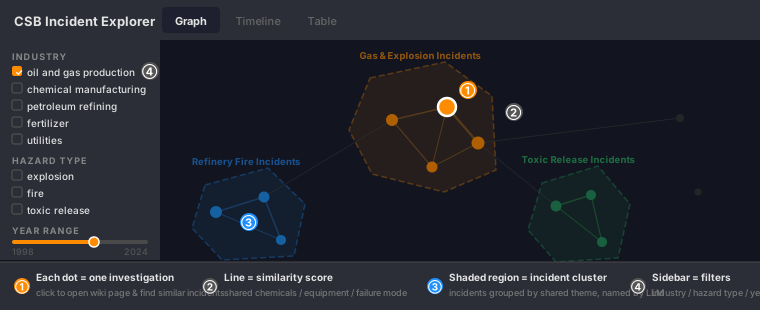
Open the graph, then use the sidebar to filter by industry, hazard type, year range, or minimum fatality count. Links on the home page (below) open the graph pre-filtered to a specific industry or hazard type.
What each incident page contains
| Section | Description |
|---|---|
| Overview | Plain-language summary of the incident |
| What Happened | Chronological sequence of events |
| Direct Causes | Immediate physical causes identified by the CSB |
| Contributing Factors | Management, organisational, and systemic factors |
| Key Lessons | Cross-cutting safety lessons from the investigation |
| Recommendations | CSB recommendations and recipient responses |
| Tags | Hazard type · Chemicals · Equipment · Industry sector |
Explore by theme
Top industries covered: Chemical Manufacturing · Petroleum Refining · Plastics · Metals · Oil And Gas Production
Most common hazard types: Chemical Release · Fire · Explosion · Structural Failure · Toxic Release
Clicking a link opens the Knowledge Graph pre-filtered to that industry or hazard type. Use the sidebar to combine filters — industry + hazard type + year range + fatality count.
In-depth analysis: Common Causes of Industrial Explosions and Chemical Plant Disasters — data-driven patterns from all 129 CSB investigations.
About this site
This site is an independent project — not affiliated with or endorsed by the U.S. Chemical Safety Board.
Data source
All incident information is sourced exclusively from CSB.gov public investigation reports. The CSB makes its final reports, safety bulletins, and recommendations freely available under U.S. government open-data policy.
How it works
This site is built on Tycho Data Compass — a platform that ingests, indexes, and structures complex document corpora and enables semantic AI search, so teams can ask natural language questions directly against their source material and publish it as a structured knowledge base.
Compass runs a multi-stage pipeline on the official CSB PDF reports:
- Crawl — CSB.gov investigation index scraped for metadata and document links
- Ingest — PDFs converted to plain text
- Label — Documents classified by type (final report, safety bulletin, etc.)
- Extract — LLM extracts structured fields per document (narrative, causes, findings, recommendations)
- Consolidate — Per-document extracts merged into a single incident record
- Render — Markdown wiki page generated from the consolidated record
- Tag — Controlled vocabulary tags assigned (hazard type, chemicals, equipment, industry sector)
- Graph — Weighted Jaccard similarity computed between every pair of incidents; agglomerative clustering groups them into named themes
!!! tip "See Compass in action for your team" Compass can ingest, index, and semantically search any document corpus — regulatory filings, maintenance records, incident reports, audit trails. Ask natural language questions against your own documents, extract structured data, and publish it at scale. Learn more about Compass →
Accuracy and limitations
- Content is generated by an LLM from source PDFs and may contain errors or omissions. Always verify critical details against the original CSB report.
- Fatality and injury counts reflect what is explicitly stated in the primary report; some investigations document ranges or revised figures in follow-up documents.
- Investigations marked "Study" or "Safety Bulletin" (rather than full investigations) may have less detailed source material.